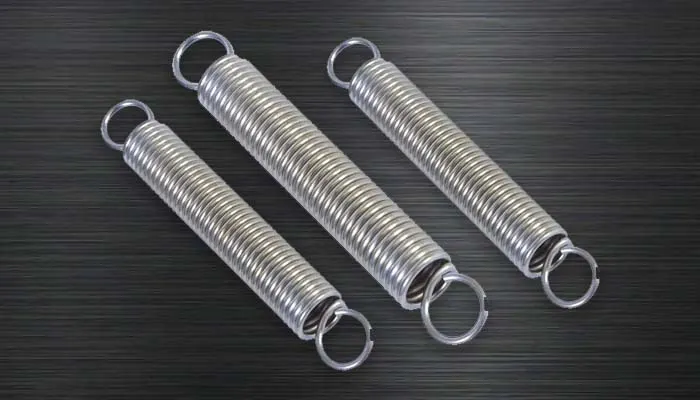
Extension Spring
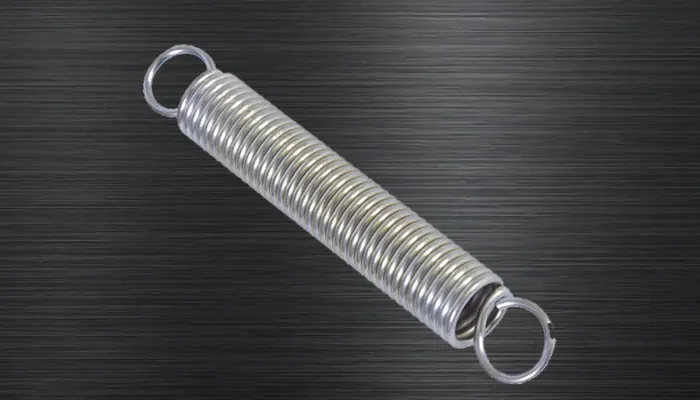
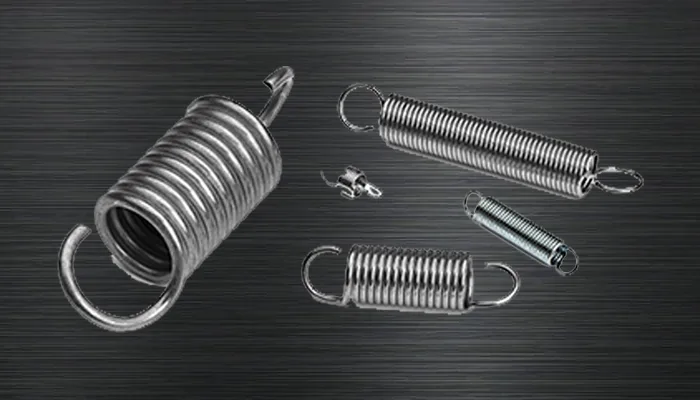
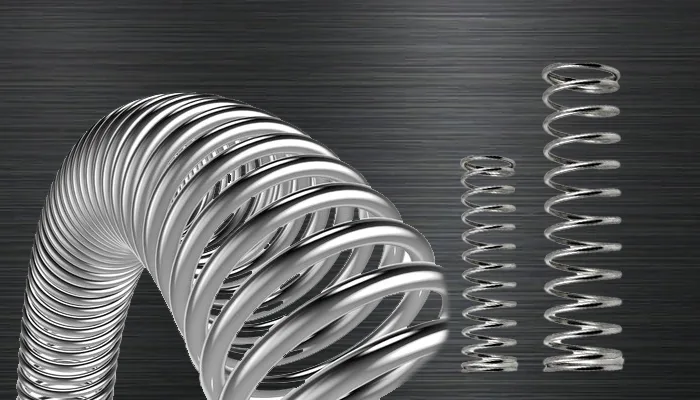
Extension springs
Extension springs absorb and store energy as well as make a protection from a pulling force. These springs are regularly connected at the both finishes to different parts and when these parts move separated, the spring attempts to unite them back once more.
Product Description
Uses of Extension Springs:
- Very much useful in car interiors and exteriors
- Also used in carburettors, toys, farm machinery and etc
- Long Helping Life.
- These are also used in garage doors
- Largely Self-damping, giving great shock assimilation and energy dissemination.
- Washing devices also need extension springs
Formulas on extension springs:
| To calculate wire diameter, |
| (OD - ID) ÷ 2 = WD |
| To calculate the outer diameter, |
| 2WD + ID = OD |
| To calculate inner diameter, |
| OD – 2WD = ID |
| To calculate mean diameter, |
| OD – WD = MD |
| ID + WD = MD |
| To calculate load |
| R = Load(L) / Distance travelled(Dt) |
Types of Extension Springs:

1. Machine Hooks: Machine hooks are typically attached to the ends of extension springs to provide a means of securely attaching the spring to other components or anchor points.
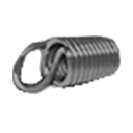
2. Center Hooks: Center hooks are typically attached to the center of the extension spring to provide a means of securely attaching the spring to other components or anchor points.

3. Side Hooks: Side hooks are typically attached to the ends of the extension spring, with the hook positioned perpendicular to the spring axis.
4. No Hooks: No hooks is a type of extension spring configuration where the ends of the spring are not formed into hooks, loops, or other attachment mechanisms.

5. Extended Hooks: Extended hooks are typically attached to the ends of the extension spring and are formed to extend beyond the end of the spring.
Merits of Extension springs:
- The extension spring is turned clockwise with the goal that it behaves like a screw stringing itself into the stop up. When the spring is embedded into the mass it works at destroying it, in this way unclogging the channel.
- Extension springs are utilized in trampolines, move around switches, shaking ponies, screen entryways, and elsewhere expanded force is important. You can find little augmentation springs, miniature expansion springs, huge expansion springs and uncompromising augmentation springs.