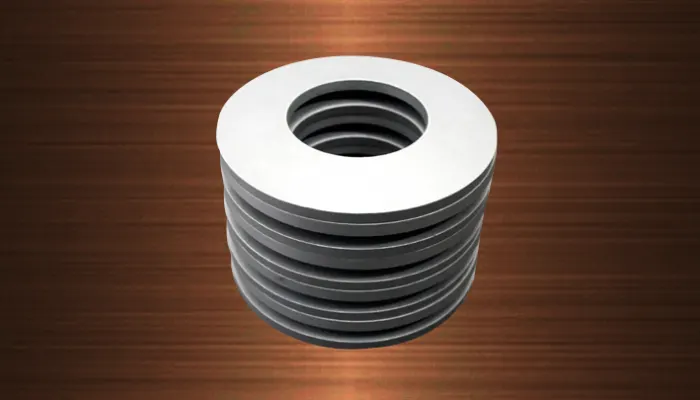
Disc Spring
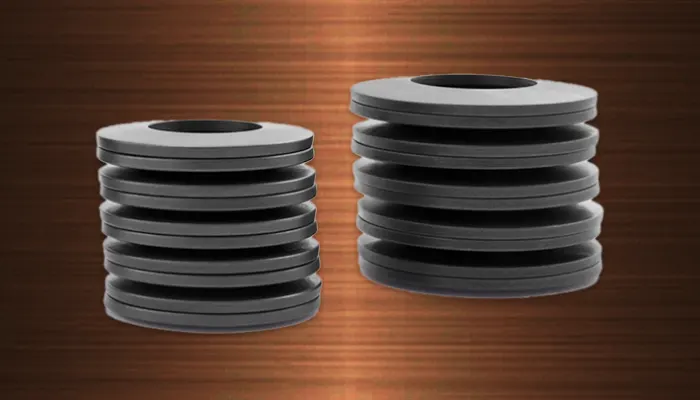
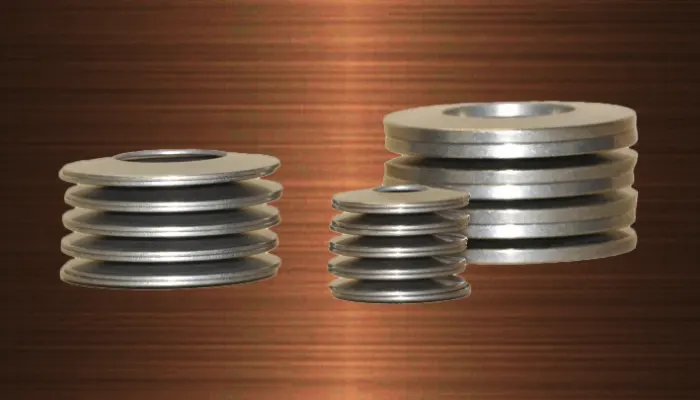
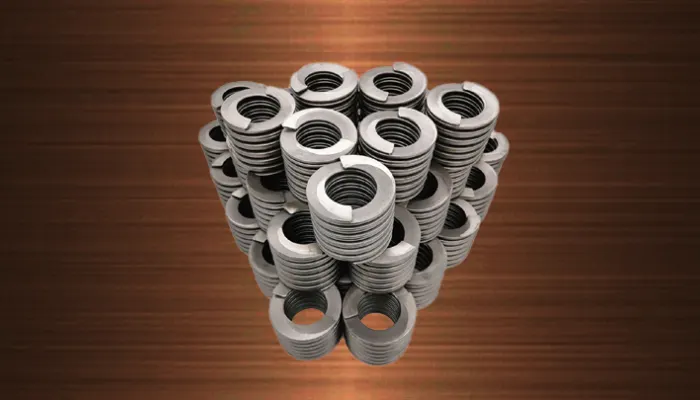
Disc Spring
Disc Springs are narrowly framed angular plates, which has stacked in the hub heading. Disc Springs have a one of a kind blend of high power in little space with tweaked deflection combination.
Product Description
Uses of Disc Springs:
- Commonly used in pressure controls and regulators
- High Energy Stockpiling Limit.
- Long Helping Life.
- Stock keeping is limited as the singular spring sizes can be joined generally
- Largely Self-damping, giving great shock assimilation and energy dissemination.
- Efficient utilization of room and high spring force with little diversions.
- Adaptable to stacking in various arrangements.
- Combination use as a particular spring component.
Merits of Disc springs:
- No Deformity or Weariness under typical burdens. equipment gatherings. They are a decent decision for applications requiring high power inside a restricted region.
- High Energy Stockpiling Limit.
- Agricultural industries also require disc springs, as it holds the necessity even there
- Stock keeping is limited as the singular spring sizes can be joined generally.
- Long Helping Life.
- Largely Self-damping, giving great shock assimilation and energy dissemination
- Efficient utilization of room and high spring force with little diversions.
- Adaptable to stacking in various arrangements.
- Combination use as a particular spring component.
Installation
- Dynamic applications, including huge quantities of avoidance cycles, will expect that notwithstanding solidified seating faces the aide surfaces should likewise be adequately difficult to forestall unreasonable wear or "venturing". For both support washers and guide components, a cleaned surface with hardness of 58HRC is adequate, and case depth ought to be 0.60mm min.
- A most significant guide to productive and expanded existence of Disc Spring is the arrangement of some type of oil. For moderately low-obligation Disc Spring application, a liberal use of reasonable strong ointment, (e .g. molybdenum-disulphide, oil), to the contact focuses and finding surfaces of the spring is satisfactory.
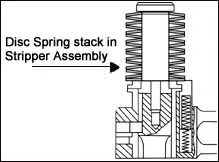
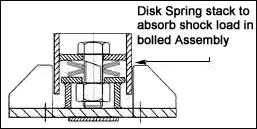
Disc Spring Stacking:
Series Stacking: The total impact of bearing point erosion of enormous quantities of Disc Springs stacked in series, can bring about the Plate Springs at each finish of the stack diverting more than those in the middle. In outrageous cases this might bring about over-pressure and untimely disappointment of the end springs. A "dependable guideline" is that the length of the stacked Plate Springs shouldn't surpass a length roughly equivalent to multiple times the external width of the Disc Spring.
Stack Length
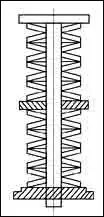
While stacking Plate Springs, exertion ought to be made to keep the stacks as short as it could be expected. Erosion and different impacts make a stack more ordinary. It diverts favoring the side of the stacking. This impact generally can be disregarded for a "ordinary" spring stack, however not so much for long stacks. On the off chance that it is longer, the stack can be balanced out by separating it with guide washers, which as a guideline ought to have a thickness of something like one and a half times of the whole diameter.
Tolerances of Disc Springs:
Disc springs, also known as Belleville washers, are conical-shaped springs that are used to apply axial force or maintain load pressure in various mechanical applications. Tolerances of disc springs typically refer to the allowable variations in the dimensions and characteristics of the disc springs, which can affect their performance. Here are some common tolerances of disc springs:
- Thickness Tolerance: The thickness tolerance of disc springs typically depends on the manufacturing process and material used. For example, disc springs manufactured by stamping or machining may have a thickness tolerance of around ±0.1 mm to ±0.3 mm.
- Outer Diameter (OD) Tolerance: The outer diameter tolerance of disc springs can vary depending on the manufacturing process and specific application requirements. Generally, disc springs may have an OD tolerance of around ±0.1 mm to ±1.0 mm.
- Inner Diameter (ID) Tolerance: The inner diameter tolerance of disc springs can also vary based on the manufacturing process and application requirements. Disc springs with smaller IDs may have tighter tolerances, typically ranging from ±0.05 mm to ±0.5 mm.
- Load Tolerance: The load tolerance of disc springs refers to the allowable variation in the load or force that the disc spring can sustain without experiencing permanent deformation.
- Flatness Tolerance: The flatness of disc springs, which affects their seating and alignment, may also have tolerance requirements.
- Surface Finish Tolerance: The surface finish of disc springs, which can affect their corrosion resistance and performance, may also have tolerance requirements.
Disc Spring Formula
The formula to calculate the spring rate of a disc spring is:
k = (G * t^3) / (8 * D^2)
Where:
- k = Spring rate or stiffness (N/mm or lb/in)
- G = Shear modulus of elasticity of the material (N/mm^2 or lb/in^2)
- t = Thickness of the disc spring (mm or in)
- D = Mean diameter of the disc spring (mm or in)
Belleville Washer
Imperial and metric sizes are available for BSI Belleville Washers. Conical spring washers, commonly known as Belleville washers, are produced in accordance with DIN 6796 and DIN 6908 Specifications. For heavy-duty bolted sections like bus bars, transformers, rectifiers, heat exchangers, transmissions, etc., BSI Belleville Washers are especially made.
LockRiteTM - Wedge Lock Washer
Maximum joint security is provided by LockRite Washers even when exposed to high vibrations and dynamic loads. Bolts are utilised in conjunction with LockRite Washers, which provide resistance to self-loosening behaviour under vibration and changing loads.
Serrated Washer
Coned washers with trapezoidal ribs across the cross section on both sides for gripping make up BSI Serrated Washers. In order to maintain preload and prevent loosening, BSI Serrated Safety Washers are ready to fit washers.