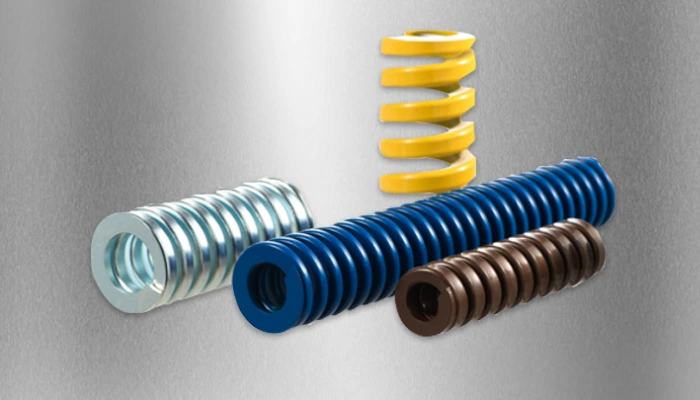
Die Spring
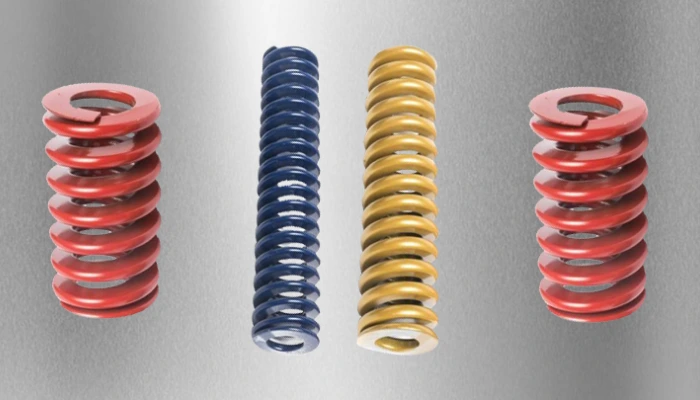
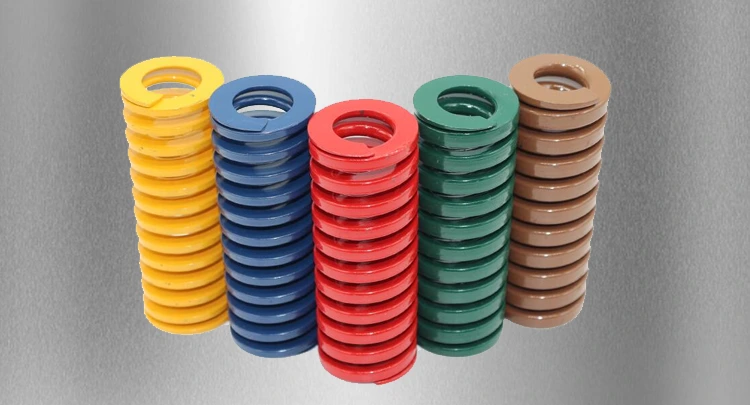
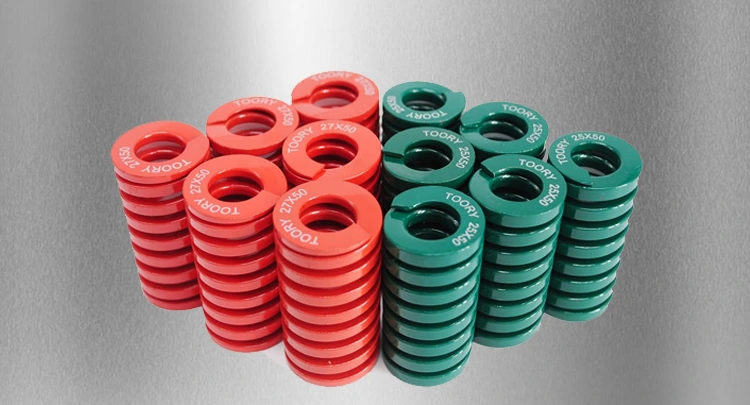
Die Spring
Die springs are the dust springs which are powerful sort of helical pressure springs comprising of rectangular wire, ordinary utilized with die sets. For a similar value deflation, Die springs convey 30% more burden. These springs are intended to convey extremely high pressure loads in threatening conditions. Made for the most part for punch presses to give steady and solid resistance, die springs likewise track down use in different industries.
Product Description
Die springs are the dust springs which are powerful sort of helical pressure springs comprising of rectangular wire, ordinary utilized with die sets. For a similar value deflation, Die springs convey 30% more burden. These springs are intended to convey extremely high pressure loads in threatening conditions. Made for the most part for punch presses to give steady and solid resistance, Die springs likewise track down use in different industries.
Formula of Die Springs:
| # | Solid Height | Wire Diameter | Pitch | Work Load and Rate |
|---|---|---|---|---|
| 1 | Lsolid = dN | d = (D Outer – D Inner) / 2 | Closed ends p = (L-3d) / Na | k = L ÷ x |
| 2 | *Lsolid = solid height | *d = wire diameter | Closed and Ground p = (l-2d)/ Na | * k = Rate |
| 3 | *d = wire diameter | *Douter = outer diameter | Double Closed Ends p = (L–5d) ÷ Na | *F = Load |
| 4 | *N = total coils | *Dinner = Inner Diameter | Open Ends p = (L–d) ÷ Na | *x = Travel |
Tolerance data of die springs:
| Group | t or t' (mm) | Tolerance for t (mm) |
|---|---|---|
| 1 | 0.2 to 0.6 >0.6 to <1.25 |
+0.02/-0.06 +0.03/-0.09 |
| 2 | 1.25 to 3.8 >3.8 to 6.0 |
+0.04/-0.12 +0.05/-0.15 |
| 3 | >6.0 to 14.0 | +0.10/-0.10 |
Spring Manufacturing
Die springs are compression springs, but differ from most in that they are a type of high force compression spring. Engineered to consistently give predetermined pressure at a given compression, die springs are well-suited for applications involving high loads or extreme conditions, like high temperatures. Die springs are often used in automotive applications or heavy machinery assemblies. They are a good choice for applications requiring high force within a limited area.
If die springs are stronger than most compression springs, does that mean it is always better to specify them? Not necessarily. Some of the products and assemblies in which springs are used require lighter weight and less bulk, making the heavy duty construction of die springs less conducive. When it comes to both compression springs and die springs, choice of material, wire diameter, and other variables are determined by the spring's ultimate use and the environment in which it will function.
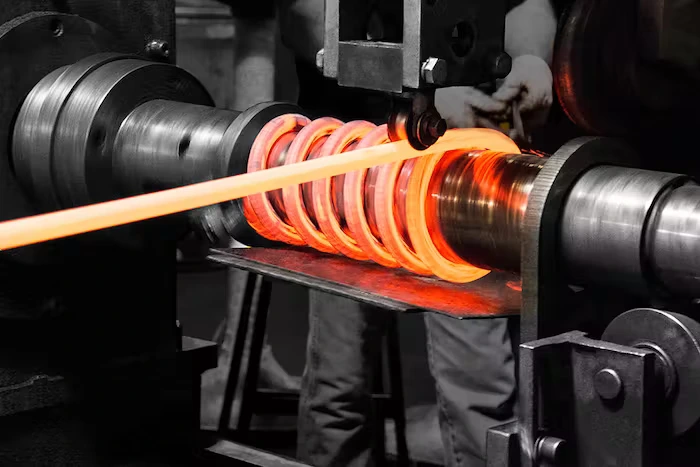
Die Spring Application
- Die springs are many times utilized in auto applications or large equipment gatherings. They are a decent decision for applications requiring high power inside a restricted region.
- They are also frequently used in transportation industry. Mostly in clutches and breaks of the vehicles.
- Agriculture industry also requires Die springs, as it holds the necessity even there
- The Die springs are very much consistent when it comes to dimensional requirements
Merits Of Die Springs:
- Magnificent execution in high-stress settings
- Accessible in a few materials, including steel and chromium combinations
- Assortment of plans and sizes
- Cost- efficient
- Handle higher burdens when contrasted with other pressure springs
- Have an extraordinary level of adaptability with regards to their applications
- Ideal for rock solid conditions
- Dependable burden bearing surface
- Consistency with regards to layered prerequisites
Die Spring Formula
The formula to calculate the spring rate of a die spring is:
k = (G * d^4) / (8 * N * D^3)
Where:
- k = Spring rate or stiffness (N/mm or lb/in)
- G = Shear modulus of elasticity of the material (N/mm^2 or lb/in^2)
- d = Wire diameter of the die spring (mm or in)
- N = Number of active coils in the die spring
- t = Thickness of the disc spring (mm or in)
- D = Mean diameter of the disc spring (mm or in)